

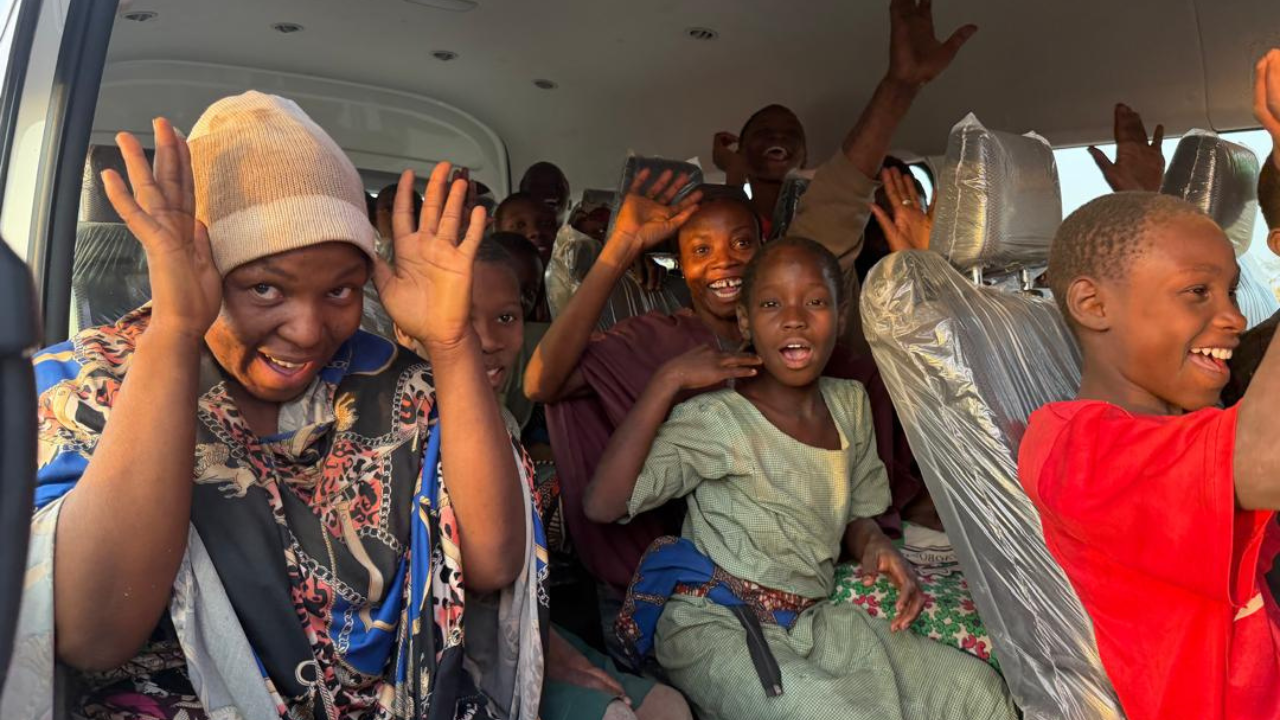
More than a month after gunmen stormed a school in central Nigeria and disappeared with hundreds of children, the last group of abducted students is preparing to return home.
On Sunday (Dec. 21,) Nigerian authorities confirmed that 130 schoolchildren kidnapped from St. Mary’s Catholic School in the Papiri community of Niger state had been released, bringing an end to an ordeal that captured international attention and revived painful memories of past mass abductions.
The children were reunited with their families on Monday, a moment of relief for parents who have endured weeks of uncertainty and fear.
The abduction unfolded last month when unknown attackers seized hundreds of students and 12 teachers from the school, located in Niger state — a vast region stretching west from Abuja toward the border with Benin. In the immediate aftermath, 50 children managed to escape on their own. Another 100 were released on December 7, leaving families anxiously awaiting news of the remaining captives.
That news came Sunday through Nigeria’s presidential spokesperson, Sunday Dare, who posted on X: “Another 130 abducted Niger state pupils released, none left in captivity.”
Yet beyond confirmation of their release, details remain scarce. The final group was reportedly freed near Nigeria’s border with Benin, but officials did not disclose how their freedom was secured or identify the group responsible for the abduction. As with earlier releases, authorities have remained silent on whether negotiations, rescues, or ransom payments played any role.
The Papiri kidnapping is part of a broader and deeply entrenched security crisis in Nigeria, where mass abductions have become a grim reality, particularly in rural areas. Armed bandit gangs operate across the north, while jihadist groups — some with external support from the Sahel — further destabilize the region. Nigeria’s security forces, often under-equipped and overstretched, struggle to contain the growing number of non-state actors exploiting vast, difficult-to-police terrain.
This was the second mass abduction in Nigeria within a single week, and the second such incident in Niger state in four years. In May 2021, gunmen kidnapped 135 pupils from an Islamic seminary in the same state. Nationally, the benchmark for global outrage remains the 2014 abduction of more than 200 schoolgirls from Chibok in northeastern Nigeria. This case spurred a worldwide campaign backed by high-profile figures including Michelle Obama and Elton John.
The scale of the crisis is stark. According to Lagos-based geopolitical advisory firm SBM Intelligence, at least 4,722 people were kidnapped across Nigeria between July 2024 and June 2025. During that period, at least 762 victims were killed, and roughly $1.66 million was paid in ransom.
International pressure has also mounted. U.S. President Donald Trump has threatened military action in Nigeria and designated the country as one of particular concern, citing what his administration has described as a “Christian genocide,” a characterization Nigerian officials have repeatedly rejected as an oversimplification of a complex security landscape.
For now, however, those debates feel distant to the families waiting in Niger state. Their children are coming home shaken, but alive. And while the silence around how they were freed may persist, the sound that matters most is the one about to be heard again: voices once stolen, finally returning to where they belong.