
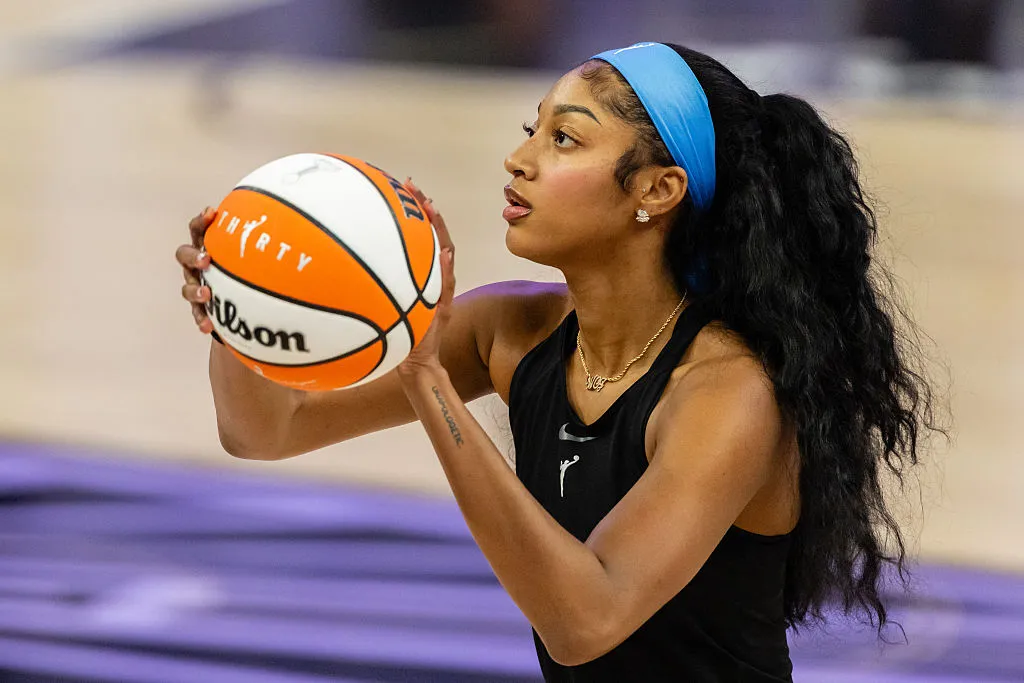
Sixty-two years, one month, and thirteen days after Dr. Martin Luther King Jr. stood before a crowd on the National Mall in Washington, D.C., to declare he had a dream of uncompromising freedom, a twenty-three-year-old basketball phenom named Angel Reese sent a brief, public transmission that contained her own declaration into the digital ether: “manifesting the finals.”
What is a manifestation if not a modern way to nudge dreams toward reality? There was no way for Reese to know then that her manifestation of a Finals appearance would not only come true but it would soon become inextricably linked to the Atlanta Dream, a women’s basketball team named after the wistful hope King laid out in the century before her birth.
As Reese pressed send on that digital transmission, the Las Vegas Aces were leading by double digits in a matchup that would end that evening with them sweeping the Phoenix Mercury in the WNBA Finals.
Reese’s second season with the Chicago Sky had already come to an early close. Individually, Reese was emerging as an unstoppable force in the WNBA, vacuuming up rebounding records and securing consecutive All-Star selections. But frustration was mounting as the Sky made little attempt to construct a winning ecosystem around its young star, missing the postseason in both of her first two years.
Seven hundred miles away, the Atlanta Dream had also faced an early end to their season. Despite a strong roster built on the defensive grit of Jordin Canada, the deep range scoring of Rhyne Howard, and the seemingly limitless energy of Allisha Gray, the team had just exited the playoffs in the first round. In its nearly two-decade history, the Dream had reached the WNBA Finals multiple times, only to leave each time without a championship trophy.
There was a cosmic irony unfolding in that moment as a generational talent was feeling stifled but still hopeful enough to manifest a dream, while a franchise born from one was chasing the same dream, neither knowing that the cosmos would lead them toward a shared orbit.
When the gravitational pull is that strong, even the rigid constraints of a rookie contract are unable to hold back the tide. The inevitable union of the two destinies materialized months later in a powerhouse trade that brought Reese to Atlanta, proving that when a destination is predestined, the paperwork ultimately bends to the higher alignment.
Anyone tracking Reese’s meteoric rise wouldn’t be surprised that her arrival instantly altered the energy pulsing through the franchise and the city of Atlanta. Reese is a generational basketball talent who has proven time and time again she was made for every moment that has presented itself to her, holding her head up and above any incoming storm of scrutiny, racial attacks, and the increasingly cold politics of a league bending to inherently anti-Black political winds.But Atlanta is part of a Black South that has always been the antidote, and holds a deep, ancestral magic, that offers a sacred sanctuary and a refuge for Black folks.
For Reese, Atlanta became a soft place to land, a city whose residents welcomed her as a daughter, a sister, a niece, and a beautiful mirror of their own power, resiliency, and brilliance. The city welcomed and enveloped her with unwavering support, visible in the instant rush to don her new jersey and the sudden, frantic race to secure a seat to witness her gifted athleticism in person.
The new atmosphere and motion around Reese instantly acknowledged the homecoming of a long-awaited sovereign. Suffice to say that although the official designation would come during the postseason, it was becoming clear that Reese’s unofficial coronation as Queen of the South occurred the moment she stepped onto Georgia soil.
In the early weeks of the season, the outside world prepared to chalk the Atlanta Dream’s season up to one focused on patience and development. Commentators preached caution, assuming that any championship hopes for Reese and the Atlanta Dream could be safely deferred to future seasons as the team’s roster was discovering how to coalesce around its new centerpiece.
Behind the scenes, a different reality was beginning to take shape as the potent mix of destiny and the determination of Reese and the team as a collective proved to be coalescing and moving on an expedited timeline.
Reese had outlined the boundaries of her hunger to win, entrusting the Dream’s coaching staff with her ambition to win the Defensive Player of the Year award. She made it clear she was ready to surrender to the process, putting in whatever work they asked of her.
On the offensive end, Dream head coach Karl Smesko had begun the meticulous and delicate work of rebuilding Reese’s shooting mechanics from the ground up, and expanded her shooting range to extend beyond the three-point line.
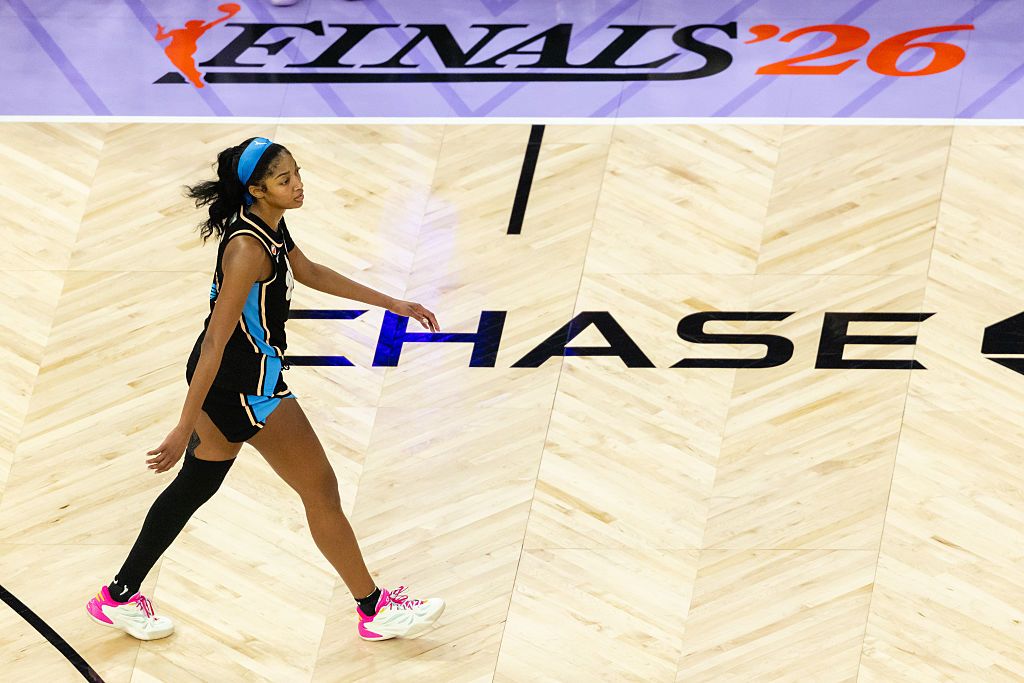
One of the biggest internal headwinds for the Dream was overcoming a fragile confidence that had erected a quiet barrier. The team had the talent to win it all, yet one missed play or error seemed to allow atmospheric doubt to infiltrate the team’s collective psyche, causing players to shrink themselves and let games slip away.
For Black fans, watching this hesitation surfaced the familiar heartache of imposter syndrome, a consequence of the hyper-scrutiny and uneven playing fields we are often forced to navigate every day in spaces where one mistake is treated as an indictment of our worth, threatening to disrupt our natural brilliance.
Reese’s arrival started to shift that psychological posture. On the court, she was aggressive and hungry to win, while on the sidelines and outside of games, she displayed a vibrant unbothered softness and a joyful sense of fun that upended the weary, restrictive trope that so often paints the assertiveness of Black women as rooted in anger.
It was clear as day to see what was developing even from the outside looking in; the youngest member of the Dream’s starting five was infusing the squad with the audacity to claim their own light.
When a reporter sensed the media spotlight might be daunting for Dream rookie Madina Okot, Reese stepped in and playfully told them to chill on her girl and not make her nervous. Okot smiled and, without skipping a beat, she quipped that she was never nervous when she was around Reese. Reese blushed as she playfully collapsed onto her rookie’s shoulder with a wide, radiant smile that laid bare the tender sisterhood that had quietly expanded across the locker room, knitting the roster together and transforming a collection of quiet individuals into a connected family.
That protective but playful chemistry, and Reese’s infusion of assured leadership, manifested itself in a broader shift in identity, as Reese reminded her teammates that they were already superstars built for the grandest stages. When the squad wanted to attend a T.I. concert as ordinary spectators, Reese flipped the script by telling them they belonged on the main stage with T.I., a declaration that became a reality.
The sisterhood forged behind closed doors quickly translated into synergy and execution on the court, a potent mix of destiny and collective determination moving on an expedited timeline. Their hunger and determination to claim their moment quickly defied conventional logic and cautious outside gazes, moving them closer to the future Reese had manifested.
The collective defiance and determination of the Dream fueled a late-season surge, amassing a thrilling winning streak that secured them the number four seed and saw Reese shatter the league’s single-season rebounding records.
The ultimate validation of just how far Reese had developed arrived early in the playoffs when Reese’s mother surprised the Dream star by presenting her with the Defensive Player of the Year trophy, a crowning moment that turned an early-season ambition into an earned and undeniable achievement.
Bernice King, the steadfast guardian and fierce defender of her father’s legacy that handed the Dream its name, often stood in the stands among the Dream faithful, watching her father’s dream come true through the brilliant athleticism and unapologetic excellence of Black women. King’s commitment to her father’s vision extended beyond the Dream. She emerged as the conscience of the WNBA, steadily holding it to account whenever it fell short in protecting Black women players across the league.
The Dream’s headwinds continued into the WNBA Finals. Denied the rightful designation of underdog despite being the lower-seeded team, the squad had to contend with a whistle that blew with agonizing asymmetry, swallowing fouls on one end while penalizing their defensive grit on the other.
The growing legion of fans and the city of Atlanta proved to be in lockstep in cheering the team on unconditionally. When scheduling conflicts moved Game 6 to the middle of a workday, Dream fans adjusted their schedules and sold out State Farm Arena, while 1.5 million TV viewers tuned in to Reese and the Dream on to victory, pushing the series to the deciding game seven.
When the final buzzer sounded during game seven, the dream Reese had sent into the digital ether was perhaps deferred, but not denied. Sixty-three years after a prophet spoke of an uncompromising freedom on the National Mall, and a year after an Angel manifested it into a dream, the basketball team named as a nod to his legacy gave what they had.
Now, they must do as King suggested on that warm summer night and pledge to march ahead, refusing to wallow in the valley of despair. There is great comfort to be found in the reminder that their journey alone is a sacred triumph for King’s home city of Atlanta and for every Black woman who refuses to dim her light in spaces willing to resort to sinister extremes to diminish and defeat her.
SEE ALSO:
Angel Reese Is The Basketball Phenom, Superstar We’ve Been Waiting For