
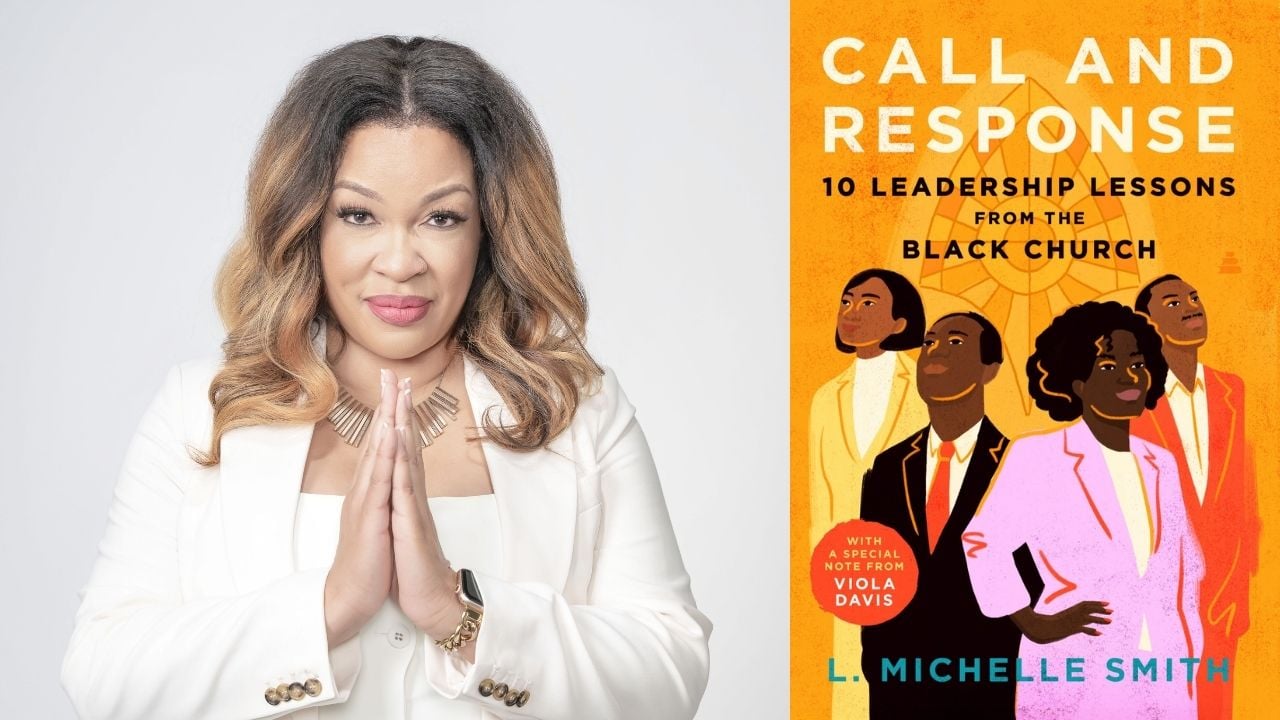
The award-winning, bestselling author and certified executive and personal coach L. Michelle Smith was nearly 25 years into her career in corporate media training before she realized where her own prowess really came from.
The corporate leader had just wrapped a talk in New York that garnered millions of impressions online when someone asked, “Where did you learn to speak like that?” Despite her background in broadcast journalism and media coaching, Smith didn’t have an immediate answer.
She spent days turning the question over in her mind. As someone who had spent years teaching others, she suddenly found herself asking: Who taught me?
“Then the answer came to me,” she told theGrio by phone on Monday, May 18. “I was teaching Sunday school to the adults at the age of 14 in church.”
Smith realized her public speaking and leadership skills had been shaped long before corporate boardrooms and keynote stages, during her childhood at Good Street Baptist Church in Dallas, Texas. That realization sprouted a larger question—if the Black church helped shape her leadership abilities, how many other Black professionals carried those same lessons into their careers?
“Was it just my church?” she wondered.
As she began asking around, Smith noticed a pattern. Her white friends didn’t know what a junior usher board was, while her Black friends who grew up in church could immediately trace many of their leadership instincts back to those experiences. What started as anecdotal, informal research eventually turned into a formal survey of 155 high-performing Black executives. Roughly 82% said they had grown up in the Black church, and roughly 76% of those said they did learn some kind of lesson that helps them today during their time there.
Those findings, alongside stories from Smith’s own background and the experiences of other Black leaders, are in her new book, “Call and Response: 10 Leadership Lessons from the Black Church,” the second release from JVL, HarperCollins imprint led by Viola Davis, Julius Tennon, and Lavaille Lavette.
“It’s nothing like it out here,” Smith said.
With a foreword by Davis and an excerpt from Henry Louis Gates Jr., “Call and Response” is a deep dive into how the Black church and its many different opportunities, from public speaking to leading, have long served as one of the country’s most influential incubators of leadership. Through cultural analysis, personal storytelling, and profiles of figures ranging from Martin Luther King Jr. to Carla Harris, entrepreneur Dominique Jones, singer-songwriter David Frazier, and more, Smith examines how generations of Black Americans developed skills in communication, resilience, collaboration, and leadership inside church communities long before many entered the boardrooms, industries, and institutions they now lead.
“What has been inspired by these leadership lessons is a whole leadership framework that I’m calling the framework for heart-centered leadership, and now more than ever — with this complex, stressful, fast-moving, highly technological environment that we’re in — layered on with the harsh leadership trends… we need it,” Smith said.
From having to read scriptures aloud in Sunday school to Youth Sunday—when the congregation’s youth take over the service annually—to leadership positions ranging from junior ushers and beyond, Black children in active Black churches are gaining a masterclass in leadership when one really looks at it. Those lessons, Smith explained, include faith and purpose, community, speaking, resilience, perseverance, collaboration, accountability, social justice, creativity and innovation, and economic empowerment.
The book arrives at a particularly interesting time in culture as Black church membership continues to decline, even while many Black communities lament the disappearance of “the village” and third spaces. Smith attributes the cultural shift to several factors, including changing habits after the COVID-19 pandemic, younger generations feeling increasingly disconnected from organized religion, and what she sees as a departure from the historical role of The Black Church itself.
“There is a distinction, because there is The Black Church, and then there are churches that have a Black pastor and some Black folks in the congregation,” Smith said.
“Our people, who were enslaved, were punished because it was against the law to worship, let alone gather in public,” she continued, describing the institution’s roots in slavery. “They ease down by the riverside, where many plantations were actually right off of rivers for economic reasons… to worship the way they wanted to, so they pull on what they remembered Grandmama and some of their ancestors were doing in Africa and mix it with what was going on in the white man’s church to have their own.”
Smith said that legacy evolved through emancipation, Jim Crow, and the Civil Rights Movement, eventually giving rise to denominations including Baptist and African Methodist Episcopal churches, while also serving as safe havens, organizing hubs, and community anchors for Black families across the country.
“Call and Response” is also Smith’s attempt to preserve and translate some of those foundational tenets for readers regardless of faith background. While the book centers the shared experiences of people raised in the Black church, Smith stressed that it is not strictly religious.
“The book does two things. It reaches to these young folks and says, ‘I see you, I know why you left. You’ve told me why you left.’ Now, pastors, I know you’re picking up this book, too. Do you see this? The book in and of itself is a call and response. There’s a call to action. There is a drain in the leader, a brain drain in the leadership pipeline from the pews,” Smith explained. “Whether we get them back or not is, I don’t know if we can, but I do know this: for those who are not of faith, this book outlines a way to build muscle in all 10 of these leadership lessons, whether you darken the door of a church or not.”