
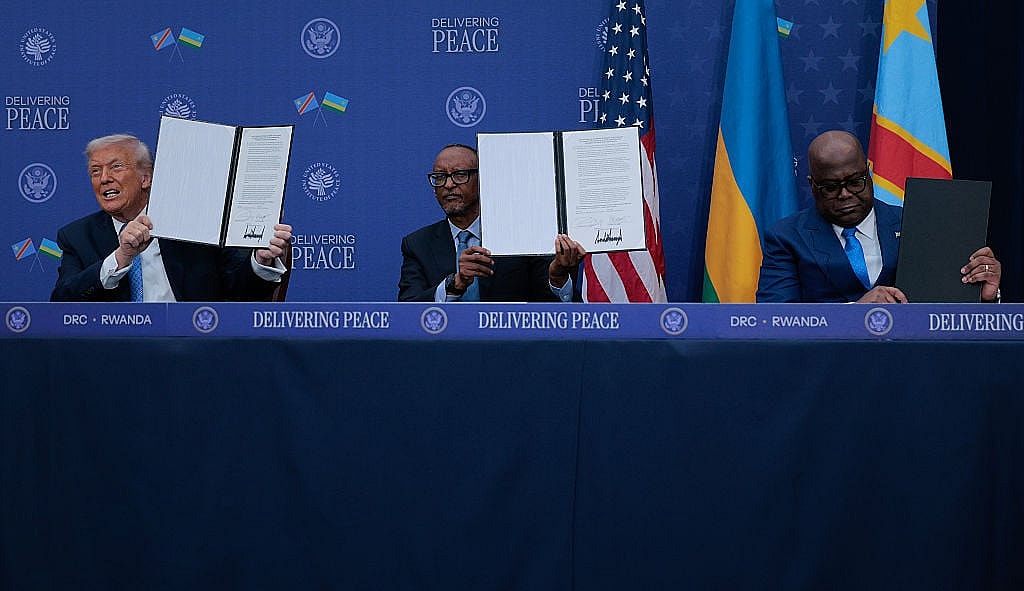
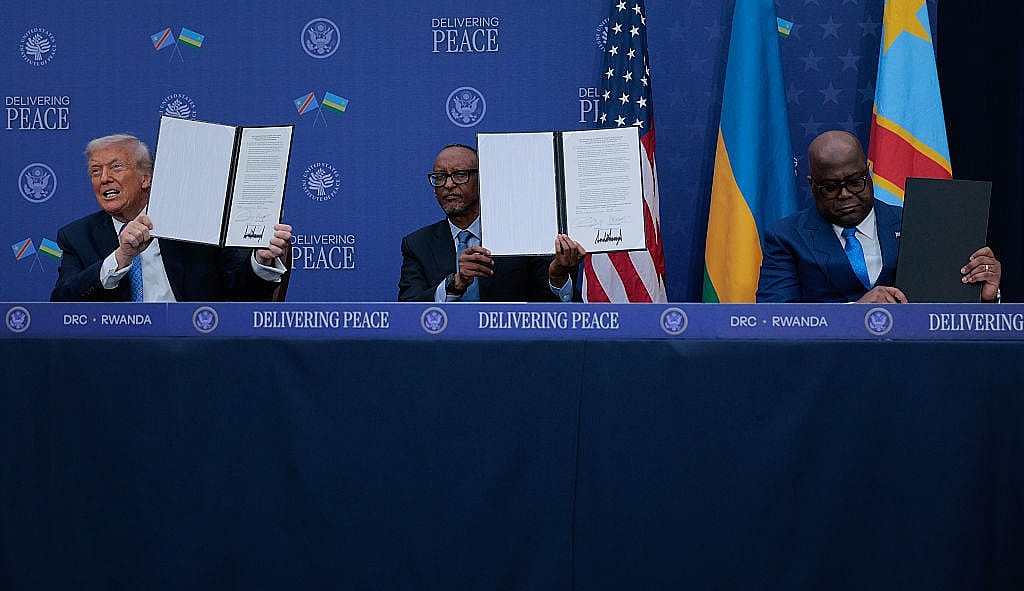
President Donald Trump led a U.S.-backed peace deal between the warring African countries of the Democratic Republic of Congo and Rwanda, which was joined by both nations’ presidents on Thursday for the deal’s landmark signing.
At the United States Institute of Peace in Washington, D.C., which was recently renamed after Trump, the president praised the deal signed with Felix Tshisekedi, president of the DRC, and Paul Kagame, president of Rwanda. He called it a “momentous occasion,” and said it was “a great day for Africa and a great day for the world.”
The deal, if adhered to by the two neighboring African countries, would mark the end of a more than 30-year conflict in eastern DRC that dates back to the 1994 Rwandan genocide. Previous attempts to make peace between Rwanda and the DRC have failed.
Acknowledging that fact, Trump said at Thursday’s peace signing, “Many administrations have tried…but we tried harder to end this conflict.”
The deal, officially known as the Washington Accords, includes several provisions, including the disengagement and disarmament of non-state armed groups, joint security coordination, the return of refugees, the enabling of humanitarian assistance, and the implementation of a regional economic integration framework.
While the Washington Accords stand to bring peace in the East African region, where millions of Africans have been killed, policy and intelligence experts tell theGrio that the deal backed by Trump would also enrich U.S. companies, the governments of Rwanda and DRC, but not necessarily its citizens, who are under authoritarian rule and suffering economic instability.
The peace deal also opens up Congo’s natural resources to global business — and U.S. businessmen close to Trump and the administration stand to make a fortune as a result.
For example, KoBold Metals, backed by billionaire investors Bill Gates, Jeff Bezos and Michael Bloomberg, already began plans to invest billions in the Congo’s large endowment of resources, reports the Financial Times. The company has deployed AI to identify untapped mineral deposits like lithium, copper and cobalt.
Reuters reports that Texas hedge fund manager Gentry Beach, who raised funds for Trump’s election campaign in 2016, is interested in gaining access to Congo’s Rubaya mine. And longtime Trump ally Erik Prince, founder of the private military contractor Blackwater, is also reportedly providing security for mineral reserve mines in Congo that were previously controlled by the M23 rebel group from Rwanda.
The peace deal includes the Regional Economic Integration Framework, which the Trump administration says will establish “mechanisms for joint coordination in areas such as energy, mineral supply chains, infrastructure, national park management and tourism, and public health and safety.”
“These efforts will attract investment, create jobs, and link the region to international trade routes like the Lobito Corridor, helping businesses and people thrive while connecting the region’s mineral sector to U.S. industry,” reads a fact sheet of the framework.
Referring to the economic framework, Trump said the African nations have some “very valuable things,” adding, “They’re gonna have a lot of money and a lot of success and I think they’re going to get along really well.”
“You have a host of other Wall Street hedge fund and business people who are lining up to invest in the mineral sector in the Congo provided that there’s some stability there and this thing moves forward,” said Maurice Carney, executive director of Friends of the Congo.
Carney told theGrio that while the framework of the peace deal will enrich the governments of Congo and Rwanda and the cadre of businessmen eyeing the region, the Congolese and Rwandan people will likely not see those benefits.
“We’re talking about the country that people say is the Saudi Arabia of the electric vehicle industry, but 70 million people still live on less than $2.15 a day,” he said.
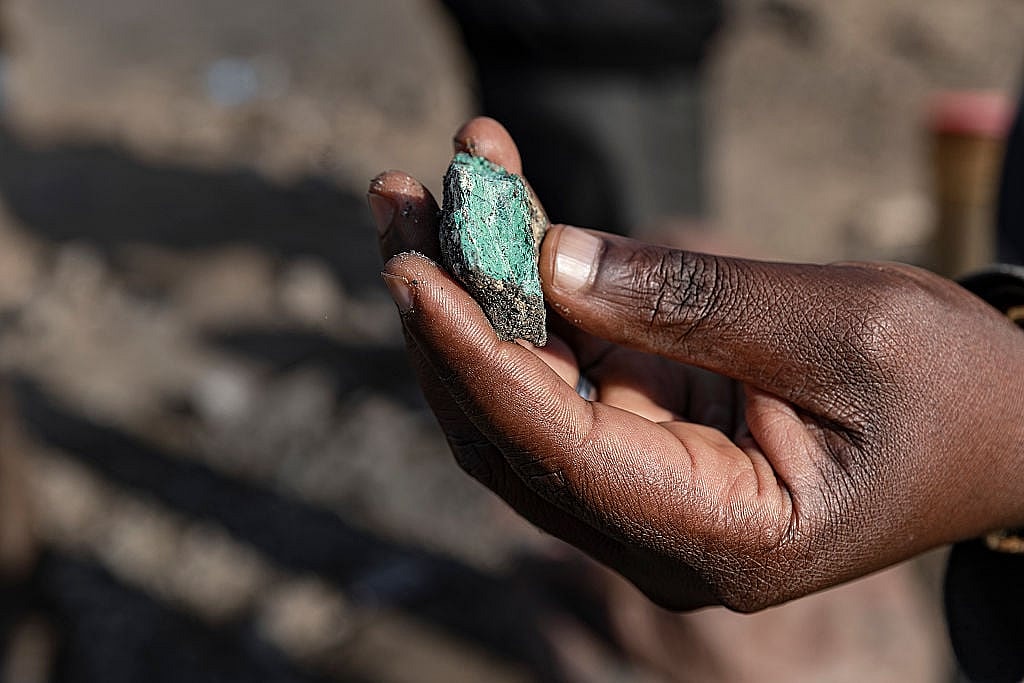
Despite Congo being in a strategic position in major industries, including AI, auto and electronics, the people are “not getting any benefit,” noted Carney.
He added, “That’s in large part due to the questions of governance the national level, where the government is not negotiating in the interests of the people.”
Joseph Tolton, executive director of Interconnected Justice, a Pan African advocacy group, told theGrio that a broader geopolitical challenge is that Rwanda and the DRC are led by dictators who have proven to put self-interests ahead of their constituents. He noted that other African leaders, such as Ugandan President Yoweri Museveni, a known dictator, and Kenyan President William Ruto, also support the deal. President Ruto, who also attended Thursday’s peace signing, has faced criticisms of authoritarian tendencies.
“They all want to be in with who they see is like the reigning dictator of the moment,” said Tolton, who added, “And obviously we know that Trump likes dictators.”
Tolton said both Presidents Tshisekedi and Kagame will earn political points for ending the bloodshed in the region, but cautioned, “The same ways in which Trump is making huge deals for himself and his family around crypto and calling the affordability crisis a hoax, these African leaders are also going to make a fortune for their countries, while the incredible economic needs that their people have go unaddressed.”
Tolton continued, “The issue is the people who are most directly impacted by this do not have a mechanism or an apparatus where by which they can make their voices heard. You cannot rise up in Rwanda and protest. There is none of that.”
In the backdrop of the Rwandan-DRC peace deal is what critics say is President Trump’s racist outlook on the African continent. Trump, who notably called African nations “shithole” countries during his first term, in recent days has referred to Somalia as “garbage” and has politically isolated South Africa over the false claim that white South African farmers are victims of a genocide.
“It is unconscionable to me that these leaders are so willing to turn the blind eye to his virulent and overt racism and Afrophobia,” said Tolton.
“These leaders are totally betraying their people, and they certainly are expressing no sense of loyalty, no sense of connection to the Black and native American experience. It’s as if it means absolutely nothing to them.”
Carney said given that Congo is the “battleground for strategic transitional critical minerals between the U.S. and China,” ultimately, the geopolitics of it all come “second fiddle to Trump’s racism.”