

At the heart of the U.S. Supreme Court’s stunning ruling that gutted a key component of the Voting Rights Act is a fundamental benchmark that Black Americans have had to wrestle with for centuries: prove that the racism they’re experiencing is real.
“Here we are once again, with the Supreme Court telling us to ignore the racism that we see right in front of our faces,” says Cliff Albright, co-founder of Black Voters Matter. He tells theGrio that Wednesday’s ruling in Louisiana v. Callais essentially tells Black voters that they’re “imagining” racism.
Referring to anti-Black Jim Crow laws that permeated the U.S. between the late 1870s and the early 1960s to prevent Blacks, primarily in the South, from voting, Albright says, “[They’re saying] ignore the noose that’s hanging from the bar…it’s all in your mind. Ignore the jelly bean tests and the poll tax and all of that. That’s not as racist as you might think. That’s just good governance.”
The more than 40-page ruling in Louisiana v. Callais, written by Justice Samuel Alito on behalf of the 6-3 conservative-majority court, significantly raised the threshold for how Black and brown communities can claim racial discrimination in voting laws. The ruling updates Section 2 of the 1965 Voting Rights Act to require voters to prove that racial discrimination is “intentional,” whether through a gerrymandered map or changes to when and how voters cast their ballots.
The ruling also grants states the right to target Black and brown voters for political reasons. As Justice Alito writes, it’s their “prerogative.” The conservative justice argues, “…vast social change has occurred throughout the country and particularly in the South, which have made great strides in ending entrenched racial discrimination.”
In making sense of Alito’s argument, Albright says, “As they’re carving up your district and diluting your vote, they’d have to be shouting from the window, ‘n-word, n-word, n-word. I don’t want the n-words to vote.’ That’s the only way that we’d be able to get any kind of justice through the Voting Rights Act.”
Voting rights advocates and civil rights attorneys, who admit they’re still making sense of the Callais ruling, fret that, without legislative intervention, the high court’s ruling has tied their hands in defending Black and brown voters in courts.
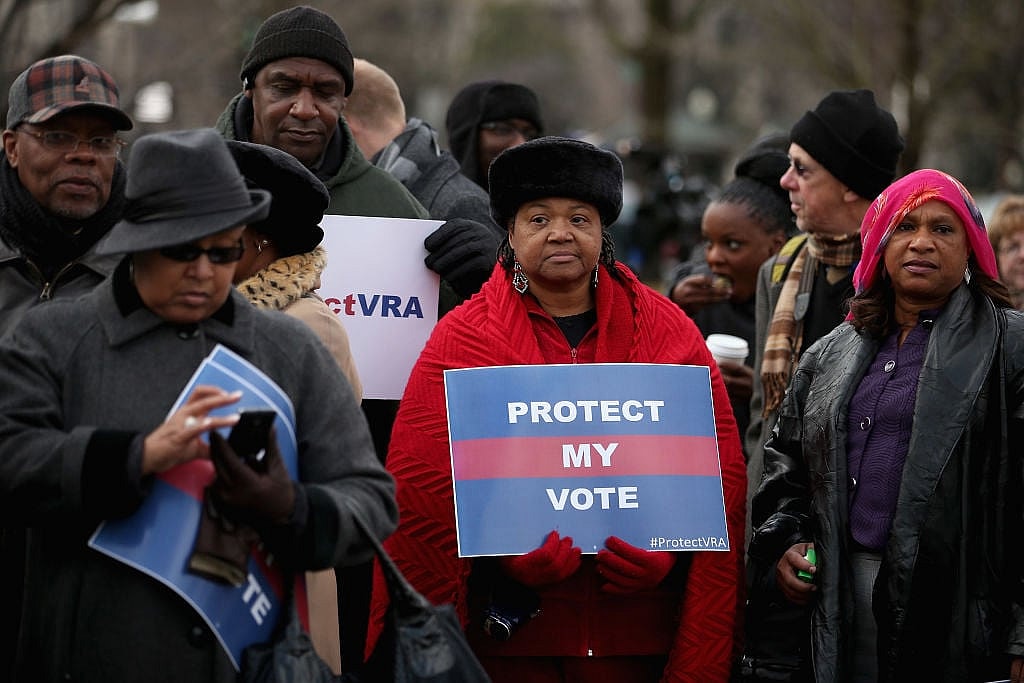
“This notion that the only way to prove discrimination is about proving intent means that…it’s very difficult to prove discrimination at all, because modern-day discrimination doesn’t work that way,” Damon Hewitt, executive director of Lawyers’ Committee for Civil Rights Under Law, tells theGrio.
Ironically, in Louisiana v. Callais, the Supreme Court ruled in favor of a group of white voters who argued that Louisiana’s creation of a second majority-Black congressional district was racially discriminatory against them under the Equal Protection Clause of the 14th Amendment.
“We’re at a point where anything that advances Black voting rights is problematic. Any claim of white grievance is invited and welcomed,” said Hewitt. “There are people who say, unless it’s intentional discrimination, the kind you saw in the 1960s with lynchings and segregated lunch counters, that’s not really discrimination, because we’ve made so much progress in this country. You see that language in this majority opinion.”
NAACP President Derrick Johnson tells theGrio that the high court opened the door to justify “proxy arguments to racially discriminate.”
“If you can align one’s political interest, one’s interest, and say this is the justifiable reason for drawing the lines, when we know for a fact that the justifiable reason is based on race and political differences, that’s a problem. That’s discrimination,” said Johnson. “What the Supreme Court is allowing legislative bodies to do across the country is to mask their deliberate discrimination against communities by calling it something else. That should not be accepted.”
Albright of Black Voters Matter compared the Louisiana v. Callais ruling to the Supreme Court’s 1857 case Dred Scott v. Sanford, in which the justices of that time ruled that enslaved Black people were not U.S. citizens and had no rights to sue in federal court. Referencing Chief Justice Roger B. Taney’s infamous opinion, Albright tells theGrio, “A Black man or Black woman has no rights which a white person is bound to respect.”
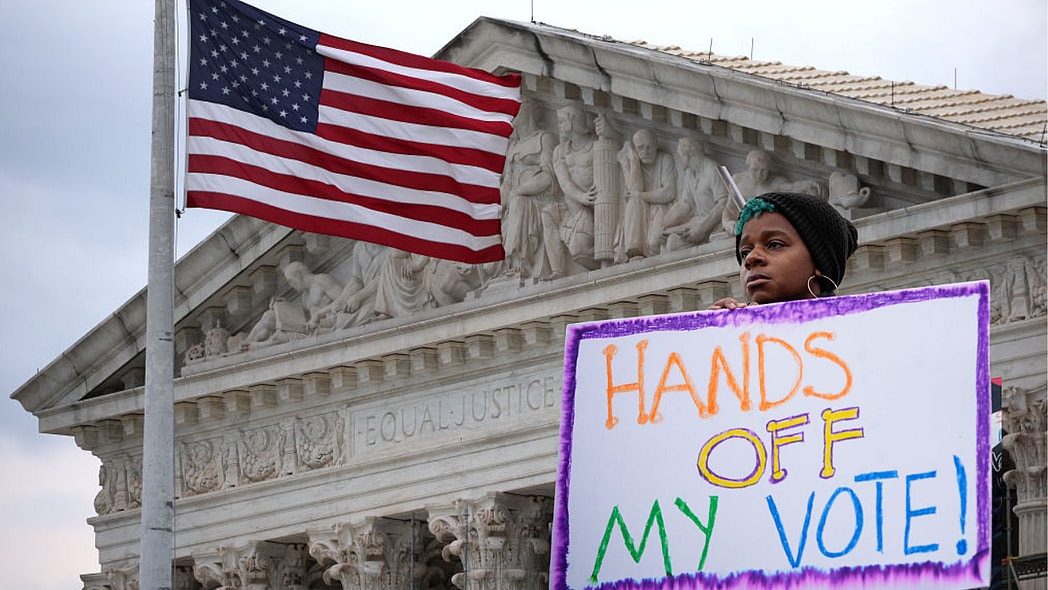
“That stings with every reminder, whether it’s a Supreme Court case or the killing of George Floyd or any of the other indignities that we face on an almost daily basis, especially from this white supremacist regime,” said the voting rights leader. “We’re angry, upset, not surprised, but most importantly, we’re resolute that we’re going to continue to fight…we’re going to get our voting rights back.”
The fight back won’t be easy and comes amid a rise in gerrymandered election maps, particularly after President Donald Trump called on Republicans in states across the country, such as Texas, North Carolina, and Missouri, to break precedent by redrawing maps mid-decade before the next scheduled U.S. Census in 2030. Democrats have responded with gerrymandered maps of their own in California and Virginia.
Various options are being discussed to restore some of the laws gutted by the Supreme Court over the years through the passing of the John R. Lewis Voting Rights Act and the Freedom to Vote Act. Reforms include banning political gerrymandering, prohibiting mid-decade redistricting, and tightening campaign finance rules.
Marc Morial, president of the National Urban League, tells theGrio that civil rights leaders would meet with allies in Congress and convene “top voting experts in the nation to ensure that the pathway forward is firm.”
“We don’t want to get ahead of ourselves, but suffice it to say we will be looking at legislative remedies,” he said, adding, “Stay tuned. I think we will have more specifics with respect to that sometime in the near future.”
Following yet another controversial ruling that has retrenched Black civil rights, some advocates and members of the Congressional Black Caucus would even like to see reforms to the Supreme Court itself, such as term limits or stacking the court to expand its current makeup of nine justices.
“Whatever we do with any of that legislation, as long as you’ve got a rogue Supreme Court that is not following legal principle, but is simply following political ideology, then whatever we get is going to be at risk, and so we certainly need Supreme Court reform,” said Albright.