
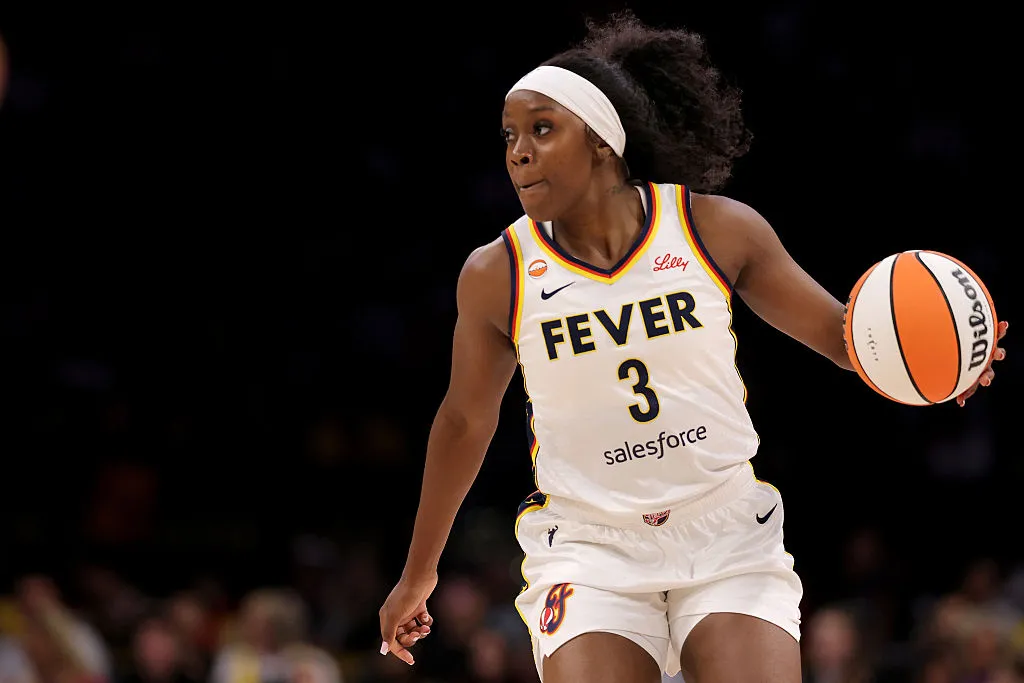
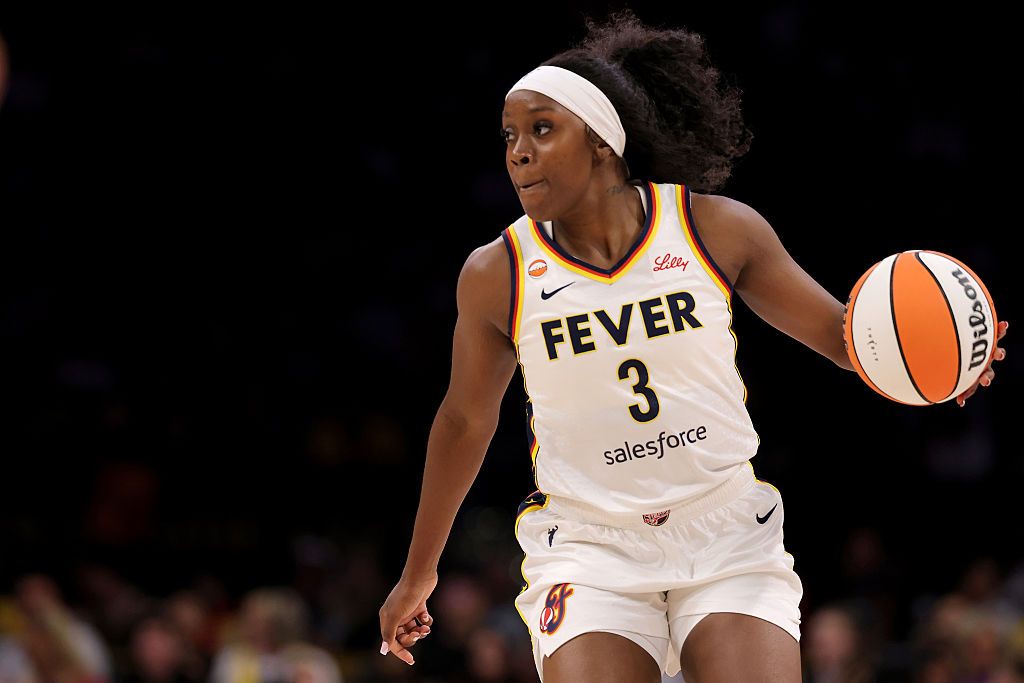
There comes a time in just about every Black woman’s career where we undoubtedly have to make a choice between falling in line with institutional racism or standing up against it. WNBA rookie Raven Johnson has faced those choices during her first season as a guard with the Indiana Fever.
During Game 2 of the first-round playoff series against the Aces, Fever forward Myisha Hines-Allen shoved Aces star A’ja Wilson on the court after a play in a clear attempt to rile up the league’s most valuable player.
The tension spilled over into a media session when Johnson put her reporter’s cap on to interview Hines-Allen about the push. When asked about the motivation behind her behavior, Hines-Allen proudly embraced the role of instigator, laughing as she reminded Johnson that she “live(s) for chaos” and is “just a rage baiter,” before adding, “That is all I am.” Standing beside her, Johnson grinned and added, “And you do it with such a smile on your face.”
By giggling and playing along with the bullying and mockery of an established Black peer, Johnson chose to fall in line with a toxic teammate rather than stand up against it. The public backlash was swift, prompting Johnson to issue an online apology in which she said she was wrong and has nothing but love and respect for Wilson, whom she called her big sister for life. Wilson and Johnson’s collegiate coach, former WNBA star Dawn Staley, reposted the apology and defended her former player, commending Johnson’s apology while highlighting her youth and talent.
This cautionary tale of sorts offers us a sobering case study on the perils of early-career assimilation for Black women entering into predominantly white spaces. Although the WNBA as a whole is a predominantly Black league, the internal and external power dynamics, combined with the team’s racial politics, qualify the Indiana Fever as a white space.
We know from studies that delve deeply into Black women’s experiences in predominantly white workplaces that Black women in corporate America are often recruited for our exceptional skills only to be absorbed into systems that demand we suppress our values and turn against other Black women, as Johnson did in the video with Hines-Allen.
Workplace demands are also different for us. Black women are often tasked with taking on heavier loads, stabilizing toxic and disorganized work environments we didn’t build, and shielding colleagues from the consequences of their shortcomings.
Earlier this year, when Johnson was chosen as the 10th overall pick of the Indiana Fever in the first round of this year’s draft, I examined her trajectory and expressed deep concern about her landing with a franchise that has routinely marginalized and taunted Black women and refuses to disavow the racists ensconced in its fanbase. I knew then that Johnson would almost immediately face this choice behind the scenes.
Before suiting up in a Fever jersey for the first time, Johnson had firsthand experience being on the receiving end of racial animosity from Fever guard Caitlin Clark and her rabid fanbase during their respective collegiate careers. Johnson has shared that the online attacks were so vicious, she considered quitting basketball. Because of that history and experience, I had hoped Johnson would steer clear of doing anything that might incite this fanbase to attack another Black woman.
Anytime a Black woman is asked to comply with the subjugation of another Black woman in the workplace, it serves to validate systemic and institutional racism. If a white player, executive, or fanbase attacks a Black woman, they are immediately called out as racist.
But if they can get Black women like Myisha Hines-Allen and Raven Johnson to deliver the blow, mock, or critique, it provides white people with total absolution. They can point to Hines-Allen and Johnson and say, “See? It’s not about race. Even these two Black women agree with us.” This deflects attention away from institutional racism by directing attention toward the spectacle of Black women fighting or policing one another.
Further complicating things, Black professionals are often fed subtle narratives by white colleagues who suggest, “You are different from them. You are one of the good ones.” Maintaining that favored status offers temporary proximity to power even as Black women are continuously pressured to distance themselves from Black colleagues who assertively push back against racism. Those who fall in line are often rewarded with the false security of praise and promotions.
While Johnson likely feels pressure to fall in line, mirroring her teammates’ toxic behavior and racial animosity won’t protect her from being on the receiving end of it again. While her compliance might feel like the easiest path to acceptance, it is a dangerous gamble.
Coach Dawn Staley was right to point out that Johnson is still young. No matter how common this experience is for Black women, it will always be unfair for a rookie to have to navigate these high-stakes workplace minefields.
Now is the time for Johnson to sit back and reflect on the choices she’s made and the choices ahead. She needs to engage with or find mentors who can provide honest and direct feedback about what is at stake and who will share how they’ve navigated these unique workplace dynamics. She should reach out to other Black women who have played for the Indiana Fever franchise to learn from their experiences and how they navigated the pressures of that ecosystem, so she can emerge with fresh blueprints.
For now, Johnson is trapped in a brutal double bind. The protection her compliance offers is a short-lived illusion. Johnson can and will be dropped by her white teammates and the Fever franchise at the very moment they no longer feel the need to weaponize her.
Once that happens, Johnson will find herself in the category of Black woman she’s choosing to distance herself from. She has an opportunity to course-correct now by realizing that true safety will never be found in the conditional approval of an institution upholding racism and players eager to use her voice against Black women who look like her.
SEE ALSO:
WNBA: Free Raven Johnson, Or At Least Protect Her
An Open Letter To Caitlin Clark From A Black Woman Who Loves The WNBA