

Jack and Jill chapters. White-gloved debutante balls. Summer cottages in Oak Bluffs on Martha’s Vineyard and beachfront enclaves in Sag Harbor. The Talented Tenth. The Links. The Boulé. All of these places and groups are unspoken pedigree checks and reference points that decide who gets past the velvet rope and into the upper echelons of the Black elite.
For generations, these institutions and gathering places have signaled one’s acceptance into America’s Black upper class, a parallel society defined and sustained by family lineage, education, and careful self-presentation. Admission into those circles is carefully curated because membership is expected to shape and govern a life’s trajectory, determining social networks, marriage prospects, and the future transfer of generational wealth.
That deliberate gatekeeping has carved a lasting divide between an insulated elite and everyday Black Americans, turning questions of taste and heritage into tests of belonging where proximity to elite status often comes with the expectation of distance from shared historical roots.
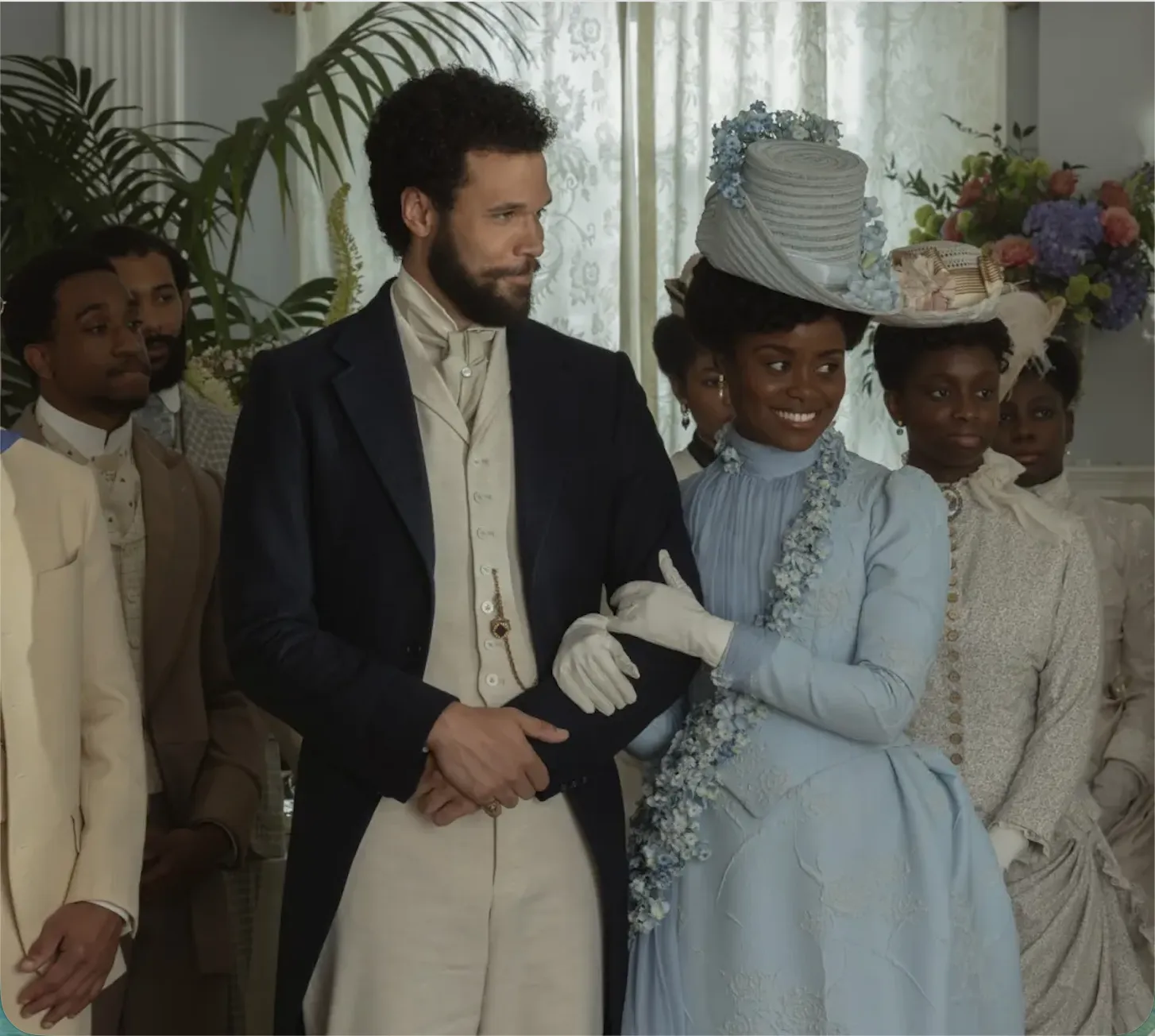
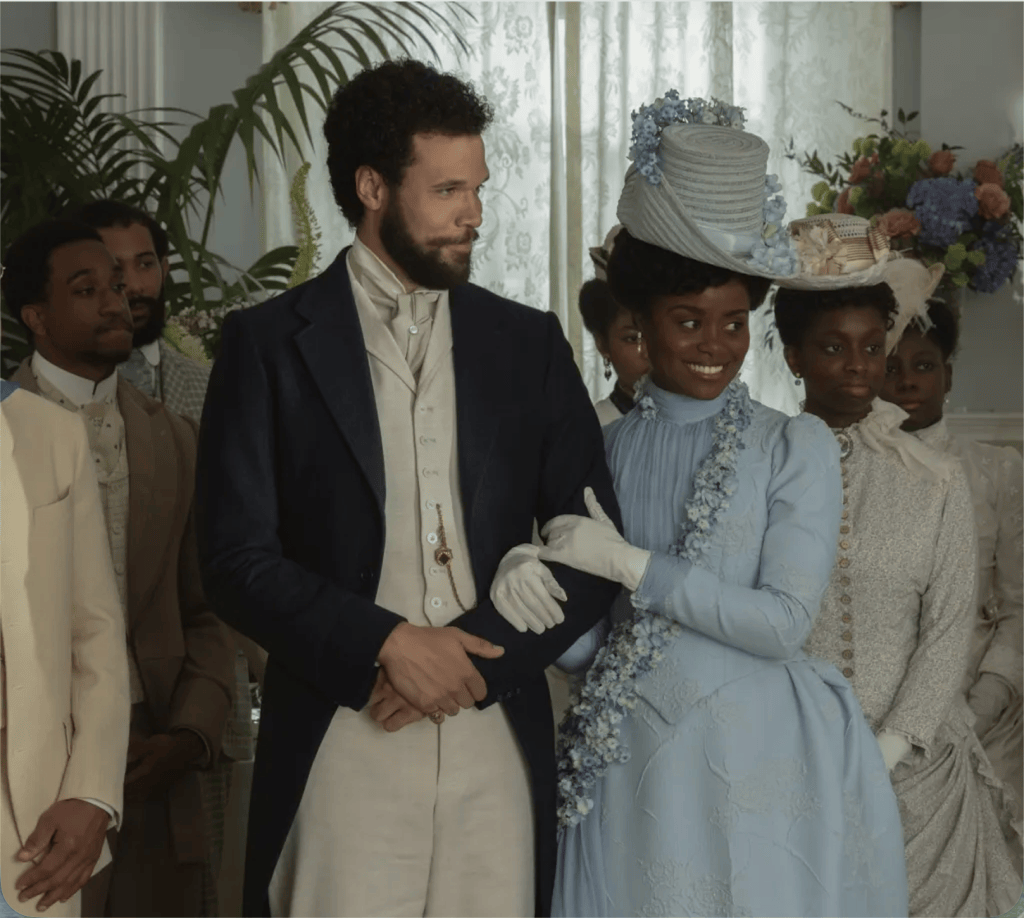
Nowhere has that divide been captured more brilliantly or vividly than in the third episode of Season 4 of HBO’s The Gilded Age, a lush historical drama chronicling the collision of old money and new wealth in 1880s New York and Newport. While the series devotes much of its attention to the feuds of white industrialists and society matrons, it also follows the romance between Peggy Scott, an ambitious young Black writer from Brooklyn, and Dr. William Kirkland, a prominent Black physician whose Newport family belongs to the city’s established Black aristocracy.
Period dramas rarely afford Black characters fullness and complexity, where romance, wealth, and ambition share the stage with the lingering wounds of slavery. Through Peggy and William’s courtship, the series brings that hidden upper-crust world into view, embracing post-Civil War Black society with rare nuance and depth.
The episode centers on Peggy and William’s Newport wedding, a union that brings two distinct Black worlds under one roof. William’s family traces its freedom back generations in the North, measuring its standing through inherited status and distance from the plantation South.
Peggy’s father, Arthur Scott, was born into slavery before building a successful pharmacy business in Brooklyn, making his wealth new and his family’s past apparent on the surface.
When the two families gather to finalize the wedding ceremony, their differences and the larger class fracture lines emerge at once after Peggy’s parents ask to include jumping the broom and a performance by the Fisk Jubilee Singers.
They are requests that immediately alarm William’s mother, Elizabeth Kirkland. For a woman whose standing rests on separating her family from its historical roots in bondage, welcoming symbols of enslavement into her son’s wedding is unconscionable and violates the unspoken rules of her class.
This internal class system emerged in the decades following the Civil War, when free Black families with early access to capital sought to distinguish themselves from the four million newly emancipated Southerners entering public life. Light skin, pre-war property, and early access to education and entrepreneurship were the initial indicators of membership in that sphere as it took root.
For those outside of that circle, exclusion meant being shut out of the networks where power and legitimacy were beginning to consolidate, reinforcing a hierarchy that measured Black respectability by how far a family was willing to stand and separate itself from any reminders of slavery. Staying inside required adhering to that unspoken rule to never remind white onlookers or upper-class peers of any proximity to slavery.
For Peggy’s parents, jumping the broom and having the Fisk Jubilee Singers perform represented cultural pride rather than embarrassment. Under slavery, jumping the broom was a way for enslaved couples to publicly declare their commitment to one another when legal marriage was forbidden.
The Fisk Jubilee Singers were an important inclusion because the celebrated a cappella ensemble once carried Negro spirituals created on Southern plantations to concert stages across the country and Europe, preserving ancestral music while raising the necessary funds to keep Fisk University open and running.
At the wedding, those opposing views play out across the room. Peggy’s parents beam with pride as their daughter marries into Newport society, seeing the inclusion of their traditions before white and Black guests alike as proof their family has arrived without surrendering its soul.
For Elizabeth, the thought of those traditions being incorporated makes her visibly wince as though their presence brings her mental anguish and physical pain. Unwilling to let reminders enter a ceremony meant to platform upper-class polish, she airs her disdain, “You want reminders of darkness on a day of celebration.”
Stepping back, the triumph of this hour of television lies in the creative choices made to unearth the fracture lines between classes and the choice not to smooth over or ignore them altogether. Rather than offering a sanitized portrait of post-Civil War success, the episode’s writers and directors center the uncomfortable friction inside Black life in ways that allow class pride, historical memory, and romantic joy to co-exist.
That intentionality extends to the episode’s title, “Ain’t That Good News,” drawn from an old Negro spiritual that rejoices in the promise of freedom, using imagery of crowns, robes, and a heavenly royal kingdom to assert a birthright of majesty and freedom. Had anyone sung a plantation hymn like that inside Elizabeth Kirkland’s parlor, that laid claim to occupying the very aristocratic throne she guards so fiercely, while doing so in a musical tradition she considers beneath her and a vestige of slavery, it would have sent her to her quarters for the rest of the day.
The song is used at the climax of the wedding as Peggy and William leap over the broom in slow motion, a victory won after William backed its inclusion and Elizabeth relented, watching the moment unfold with genuine happiness. Surrounded by celebrating family and friends from both circles, the newlyweds leap into their future together, blending the two worlds with joy and showing it is possible to both honor where you come from and celebrate where you are going.
SEE ALSO:
Why Mother Nature Should Be Time’s 2026 Person Of The Year
Let’s Talk About The Battle Over Who Does Black Women’s Hair