

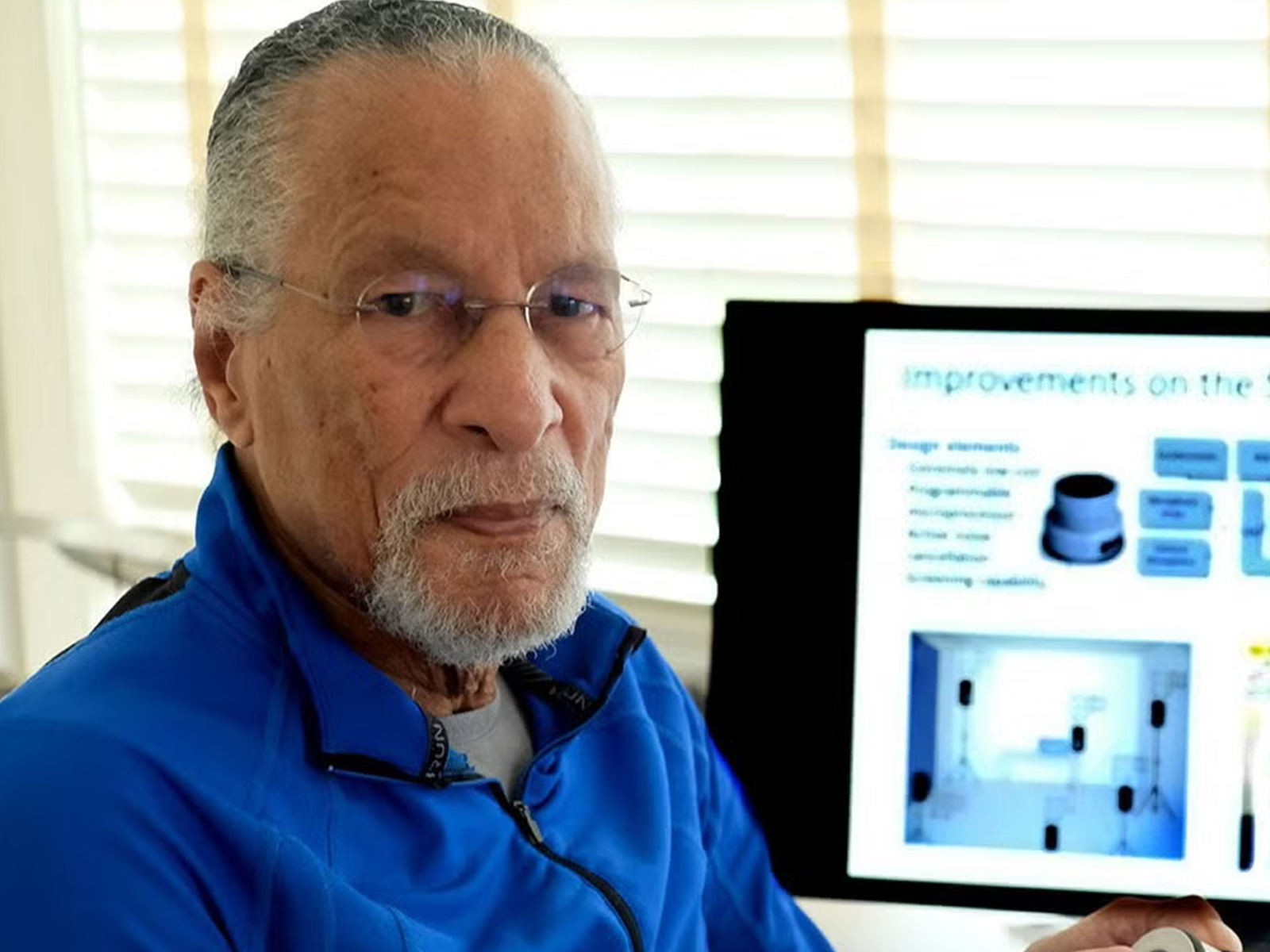
From smartphones and hearing aids to recording studios and baby monitors, microphones are essential to modern life. Yet many people may not know the name of the Black inventor whose groundbreaking work helped make these devices smaller, more affordable and widely accessible. James Edward Maceo West, an accomplished scientist and acoustics expert, helped revolutionize sound technology while becoming a strong advocate for greater diversity in science and engineering.
Born February 10, 1931, in Farmville, Virginia, West developed an early fascination with understanding how things worked. Growing up during segregation, he encountered racial barriers that tried to limited opportunities for Black Americans. He was born in his maternal grandfather’s home because the local hospital would not admit Black patients.
West’s curiosity was encouraged by his family, particularly his mother, Matilda, a schoolteacher who later worked at Langley Research Center. Her involvement with the National Association for the Advancement of Colored People (NAACP) cost her that position, an experience that helped shape West’s lifelong commitment to confronting discrimination and expanding opportunities for underrepresented people.
Initially pursuing medicine, West eventually followed his interest in science and electronics. After serving in the U.S. Army, he attended Temple University, where he studied physics. During his college years, he gained valuable experience through internships at Bell Laboratories, an organization that would become central to his professional career.
In 1957, West joined Bell Laboratories and began work in electroacoustics and related fields. There, he partnered with German scientist Gerhard Sessler to develop a new type of microphone that could deliver high-quality sound in a compact, lightweight and affordable design.
Their work resulted in the foil electret microphone, patented in 1962. Unlike many earlier microphone designs, the technology did not require an external direct-current bias. Its performance, reliability, small size and relatively low cost helped it become a standard component in modern audio technology.
The invention’s impact has been extraordinary. According to the information documented about West’s work, electret-based microphones account for nearly 90 percent of microphones manufactured annually. Their applications range from telephones and audio-recording equipment to hearing aids, toys and baby monitors.
West’s contributions extended well beyond his invention. During his decades at Bell Laboratories, he helped establish programs that created research opportunities for women and underrepresented minorities pursuing advanced degrees in science and engineering. He also co-founded the Association of Black Laboratory Employees, which worked to address workplace advancement and promotion concerns.
After retiring from Bell Laboratories in 2001, West joined the faculty of Johns Hopkins University, where he continued his work as a professor of electrical and computer engineering. His achievements earned numerous honors, including the National Medal of Technology and Innovation in 2006. He was inducted into the National Inventors Hall of Fame in 1999.
West’s legacy represents more than scientific achievement. His story demonstrates how curiosity, determination and perseverance can overcome significant barriers. Through his invention, he changed the way people communicate and experience sound. Through his advocacy, he worked to ensure that future generations of innovators would have greater opportunities to contribute their talents.
For young people considering careers in science, technology, engineering and mathematics, James E. West offers a powerful example of what is possible when talent is matched with persistence and a commitment to making
a difference.
By Unite Staff,